Turaska is a historical term rooted in Sanskrit that ancient Indian writers used to describe foreign peoples, particularly groups connected to Central Asia and the northwestern frontier. The word carries centuries of linguistic and cultural weight — appearing in epics, chronicles, medieval inscriptions, and even modern Bengali dictionaries. Understanding it requires moving through several layers: language, identity, geography, and political history.
What Is Turaska? Meaning and Definition
At its simplest, the term functions as an ethnonym — a label used to name or categorize an outside group. In older Indian writing, it pointed broadly to foreign peoples living beyond the familiar cultural and political world. It did not always describe one fixed nation or tribe. Instead, it worked as a flexible label that shifted in scope depending on the text and period.
Turaska as a Sanskrit Ethnonym
Sanskrit literature developed a rich system for naming outsiders. Terms like this one helped writers organize the known world into familiar and unfamiliar zones. The word belonged to a broader vocabulary of border peoples, foreign tribes, and culturally distinct communities — not simply as a geographic marker, but as a tool of categorization.
This is why studying it connects directly to how ancient Indian society understood difference, identity, and cultural space.
Turaska in Bengali Usage
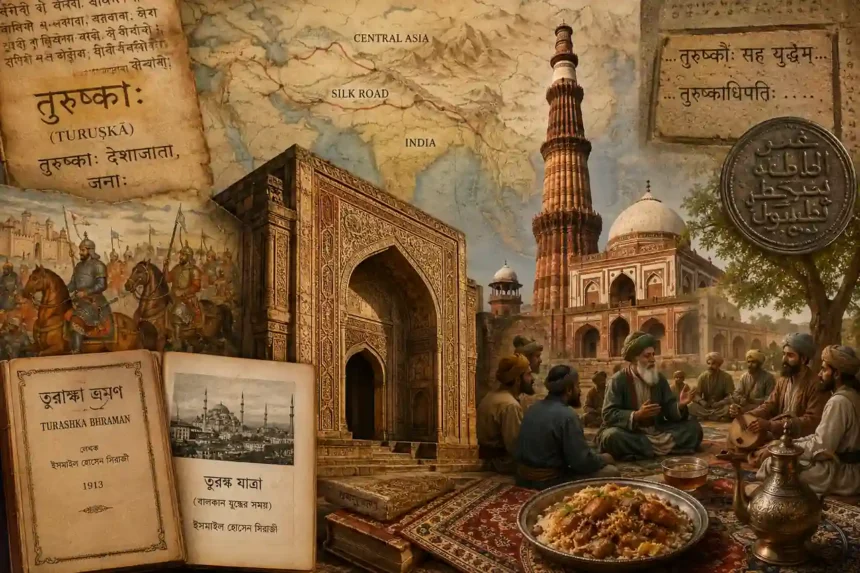
In modern Bengali, the word translates directly to “Turkey.” A Bengali-English dictionary entry confirms this clean language connection. But its literary roots run deeper. Cambridge research has documented Turashka Bhraman, a 1913 travelogue written by Ismail Hossain Siraji based on his journey to Turkey during the Balkan War. The text places the term firmly inside Bengali intellectual and Muslim political thought — well before the digital age made the word searchable.
That dual existence — as a translation word and a historical term — is exactly why readers keep returning to it.
Origin and Etymology of Turaska
Sanskrit Roots of Turuṣka / Turushka
The word is most closely studied through its Sanskrit forms: Turuṣka and Turushka. These spellings appear consistently in historical scholarship and literary discussion as terms for peoples linked to the Central Asian frontier. The modern spelling “Turaska” is a simplified transliteration — one that emerged as the term traveled across scripts, regions, and centuries.
Linguists studying historical linguistics place it within a broader pattern of how Sanskrit encoded contact with the outside world. The fact that the word survived multiple transliteration forms while retaining its core historical sense points to a strong and stable identity within the tradition.
Evolution of the Word Over Time
Early uses of the term tended to be broad — covering frontier populations in general. Over time, as Indo-Turkic relations became more historically defined, the word narrowed and became more politically specific. It began tracking real events rather than imagined outsiders.
This kind of meaning shift is common in language evolution. Words respond to the societies that use them. As people moved, traded, and fought, the label adapted — absorbing new political realities while carrying older cultural memory forward.
Turaska in Ancient Indian Texts
Mentions in Puranas and Epics
The term appears in foundational Sanskrit works including the Mahabharata, Vishnu Purana, Bhavishya Purana, and Ramayana. These texts are not historical records in the modern sense — they blend narrative, belief, cultural memory, and social ideas. But they are invaluable precisely because of that blend.
Within these sources, the word names groups living beyond the familiar social order. It signals distance, movement, and awareness of a wider world. References to foreign peoples in these epics reveal how ancient Indian writers built their mental map of neighboring regions and the peoples within them.
Turaska in Kathasaritsagara and Rajatarangini
Two texts deserve special attention. The Kathasaritsagara, compiled by Somadeva, is a vast collection of narratives where foreign characters and borderland settings appear often enough to make the term contextually meaningful. Here, it shapes the imaginative world of the story — marking outsiders and giving movement to the plot.
The Rajatarangini, written by Kalhana as a historical chronicle of Kashmir, provides a different kind of evidence. It places the term inside real frontier politics — military movement, regional conflict, and the pressures of neighboring powers. That makes it especially valuable for anyone studying medieval Indian history and the layered past of the northwestern subcontinent.
Turaska and Central Asian History
Central Asian Tribes and Migrations
The term’s historical background is inseparable from the long movement of peoples across Eurasia. Nomadic tribes from the Central Asian steppe — horse-riding, cavalry-driven, and militarily capable — shaped the frontier world that Indian writers were trying to describe. Communities from regions that today include Kazakhstan and Uzbekistan carried traditions, languages, and stories across mountains and deserts for centuries.
As these groups migrated, labels migrated with them. The word became one of the terms that absorbed this movement — a linguistic marker of real-world contact.
Cultural Exchange Between India and Central Asia
The relationship between India and Central Asia was never only about war. The Silk Road trade network created sustained contact through commerce, diplomacy, and the movement of scholars, merchants, and holy men. These exchanges influenced how Indian authors understood the wider world — and how they recorded it.
The term captures that exchange in compressed form. It is a reminder that the subcontinent was always part of a broader Asian story, not an isolated civilization sealed off from its neighbors.
Turaska and Foreign Peoples in Indian Writing
Ancient Indian writing developed a layered approach to describing outsiders. Northern tribes, frontier peoples, and groups arriving through trade or conflict were each given labels that helped organize social and political reality. JSTOR records confirm that the related form Turushka appears in Sanskrit inscriptions and medieval Sanskrit texts — sometimes describing Turks, sometimes used more broadly for Muslims depending on the historical setting.
This matters because it shows the term was never rigidly defined. It functioned more like a category than a name. Writers applied it where it fit, and readers understood its approximate meaning from context. That flexibility made it durable across centuries of use.
Turaska and the Turkic Invasions of India
The word’s connection to Turkic invasions sharpened its meaning considerably. As Turkic military groups entered northern India and began reshaping political power, Indian writers needed language that could describe these new forces. The term moved from literary use into historical commentary.
Mahmud of Ghazni and his raids into northern India during the 11th century represent the period when outside military pressure became undeniable. For writers of that era, the label no longer pointed to distant strangers from old stories. It pointed to real armies, attacked temples, and changed kingdoms. The word carried genuine political weight.
How Turaska Shaped Indian Civilization
Turaska and Indo-Islamic Architecture
One of the most visible legacies of this era of contact is architectural. As Turkic and Central Asian rulers established courts in India, they brought new building traditions. The result was not imitation — it was synthesis. Indo-Islamic architecture combined arches, domes, and geometric stonework with local Indian design sensibilities.
Monuments like the Qutb Minar and the Alai Darwaza stand as physical evidence of this meeting of traditions. The decorative patterns, palace layouts, mosques, and gates from this period reflect a design blend that belongs equally to Central Asia and to India.
Turaska and Language Change
Court culture shifted alongside political power. Persian became the dominant language of administration, poetry, and intellectual life across many royal courts. This changed how records were kept, how orders were issued, and how history was written. Over time, Persian and Arabic vocabulary blended with local Indian languages — a long process of linguistic contact that contributed directly to the development of Urdu.
Language rarely stays pure when people live together for generations. The result here was one of South Asia’s richest literary traditions.
Turaska and Religion and Daily Life
Sufism played a major role in bridging communities during this period. Sufi teachers and saints drew people from different backgrounds through a message centered on prayer, love, and human connection. Their spaces became meeting points. Over time, music, festivals, food, clothing, and daily customs began to reflect this ongoing cultural blend.
This dimension of the story is often underemphasized. Contact between communities shaped more than politics and architecture — it shaped daily life at the neighborhood level.
Turaska vs Other Sanskrit Ethnonyms
| Term | Primary Association | Scope |
| Turaska / Turushka | Central Asian, Turkic-linked peoples | More specifically, frontier-focused |
| Mleccha | Broad category for outsiders, foreigners | Widest scope, often ritual-focused |
| Yavana | Greeks, western outsiders | Historically tied to Hellenistic contact |
Understanding how these terms differed helps clarify how Sanskrit texts organized human diversity. They were not random labels. Each carried a distinct historical texture tied to geography, perceived cultural distance, and political context.
Linguistic Evolution and Regional Adaptations of Turaska
The word did not stay in one form. Across different regions and scripts, it picked up variants, translations, and local interpretations. Scholars studying the evolution of ethnonyms treat this kind of variation as evidence of the word’s durability, not its weakness.
Regional adaptations show how language survives across historical distances — by changing shape while preserving meaning. The fact that the term appears in Sanskrit inscriptions, medieval chronicles, Bengali travelogues, and modern dictionaries confirms that it held enough meaning across enough contexts to remain worth using.
Modern Relevance and Digital Interest in Turaska
Today, the term draws attention for multiple reasons. Historians and linguists use it as a tool for studying historical linguistics and the cultural ties between the Indian subcontinent and Central Asia. In academic settings, it remains a reliable entry point into questions of identity, ethnography, and political change in medieval South Asia.
Online, its growth reflects something slightly different. In 2022, Turkey formally requested that international organizations adopt the spelling Türkiye. The U.S. State Department confirmed adoption of the preferred spelling in official use. This public conversation about country names kept Turkey-related language active in global search. Terms like this one — rare, history-linked, and connected to Turkish identity — attracted new curiosity from readers exploring the linguistic background.
Social media and digital libraries have also played a role. Young people in Central Asia and South Asia now access old texts and share cultural stories online, giving historically rooted terms renewed visibility in 2026.
Conclusion
Turaska is more than an old word recovered from Sanskrit literature. It is a point of intersection — between language and history, between India and Central Asia, between ancient narrative and medieval political reality. From its earliest appearances in the Mahabharata and Puranas to its use in the chronicles of Kashmir and the travelogues of Bengali writers, the term has consistently tracked the movement of peoples and the contact between cultures.
Its legacy is visible in stone, in language, and in daily life. Indo-Islamic architecture, the development of Urdu, the spread of Sufism — all of these connect, in part, to the long history of contact that this term once named. Studying it honestly means accepting that South Asian history was always shaped by movement, trade, migration, and exchange. The Silk Road was not a metaphor — it was a living network, and this word was part of how people recorded what they encountered along it.
FAQs
What does Turaska mean?
It is a historical term used in ancient Indian writing to describe foreign peoples, particularly those connected to Central Asia and Turkic-linked frontier regions. In modern Bengali, it translates directly to “Turkey.”
Is Turaska the same as Turuṣka or Turushka?
They are closely related. Turuṣka and Turushka are the older Sanskrit forms. The spelling Turaska is a simplified modern transliteration of the same root term.
Where does the word Turaska come from?
Most scholars link it to Sanskrit, with possible connections to Old Persian. It developed within a broader Indo-European and Turkic language contact zone, reflecting centuries of interaction between South and Central Asia.
Where is Turaska mentioned in ancient texts?
It appears in connection with the Mahabharata, Vishnu Purana, Bhavishya Purana, Ramayana, Kathasaritsagara, and Rajatarangini. The related form Turushka also appears in Sanskrit inscriptions documented in JSTOR records.
How is Turaska different from Mleccha and Yavana?
Mleccha was the broadest term for outsiders, often tied to ritual impurity. Yavana referred more specifically to Greeks and Western foreigners. This term was more closely tied to Central Asian and Turkic-linked peoples.
What is Turashka Bhraman?
It is a 1913 Bengali travelogue written by Ismail Hossain Siraji about his journey to Turkey during the Balkan War. Cambridge research has documented it as a significant text in Bengali literary and Muslim political history.
Is Turaska related to Turkey or Türkiye?
In Bengali, the word is a direct translation of Turkey. The historical Sanskrit forms (Turushka, Turuṣka) refer to Turkic peoples more broadly. They share a linguistic root but operate in different historical contexts. Turkey’s 2022 request to use the spelling Türkiye in official international use has renewed general interest in Turkey-related terminology.
Why is Turaska still relevant today?
It remains useful for scholars studying historical linguistics, medieval South Asian history, and Indo-Central Asian cultural exchange. Online, it draws growing search interest in 2026 due to its connection to Turkish identity, Bengali literary history, and the broader academic study of ethnonyms in Sanskrit texts.