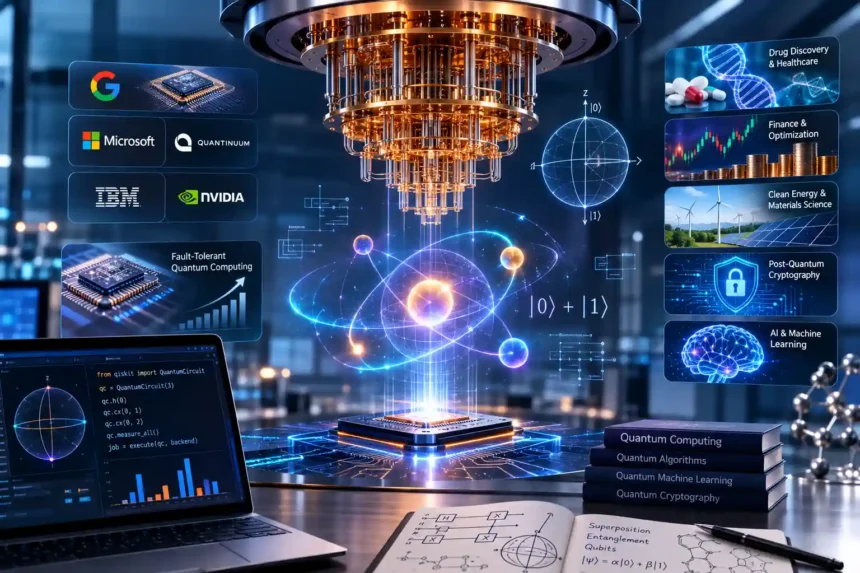
The latest breakthroughs in quantum computing 2024 mark the year the field moved from lab experiments to working, testable systems. Google, Microsoft, and Quantum each solved a piece of the error problem that had blocked progress for decades. For the first time, adding more qubits made systems more reliable instead of less. That single shift changed how researchers, investors, and companies think about the technology’s timeline.
This article breaks down what actually happened, why it matters, and what still needs to be solved before quantum computers can do useful work at scale.
What Is Quantum Computing? (Foundations)
Quantum computing processes information using qubits instead of classical bits. A classical bit holds a 0 or a 1. A qubit can hold both values at once, a property called superposition.
Qubits can also be linked through entanglement, so changing one instantly affects another. This lets quantum systems explore many possible answers at the same time.

Two types of qubits matter here:
- Physical qubits — the raw hardware units on a chip
- Logical qubits — reliable units built from grouping several physical qubits together with error correction
The catch is decoherence. Qubits are fragile. Heat, vibration, or stray electromagnetic noise can wreck a calculation in microseconds. Most systems today run in the NISQ era — noisy, intermediate-scale devices with tens to a few hundred qubits. They’re useful for narrow experiments but can’t yet run large, general-purpose programs.
Google’s Willow Chip and Quantum Error Correction

In December 2024, Google Quantum AI introduced Willow, a 105-qubit superconducting chip. It solved a problem researchers had chased for almost 30 years: below-threshold quantum error correction.
Google arranged qubits into grids of increasing size — 3×3, 5×5, and 7×7. Each time the grid grew, the error rate dropped instead of rising. That’s the opposite of what happened with every earlier generation of quantum hardware.
Willow also ran a stress test called random circuit sampling. It finished in under five minutes what Google estimated would take a classical supercomputer roughly ten septillion years — a number far larger than the age of the universe.
The benchmark itself had no direct business use. But the error correction result did. It proved that scaling up qubit count can actually reduce noise, which is the core requirement for building fault-tolerant machines.
Microsoft and Quantinuum’s Logical Qubit Breakthrough
In April 2024, Microsoft and Quantinuum announced a separate but equally important result. Using Quantinuum’s H2 ion-trap hardware and Microsoft’s qubit-virtualization system, they created four highly reliable logical qubits from just 30 physical qubits.
The logical error rate came in 800 times lower than the physical error rate underneath it. The team also ran 14,000 independent circuit instances without a single error — a reliability level that had never been demonstrated at this scale.
Later in 2024, the same partnership scaled the work further, producing 12 logical qubits and running a hybrid quantum-classical chemistry simulation. That combination — quantum hardware handling one part of a calculation, classical computing handling the rest — is becoming the standard approach for near-term applications.
| Result | Detail |
| Logical qubits created | 4 (later scaled to 12) |
| Physical qubits used | 30 |
| Error rate improvement | 800x lower than physical qubits |
| Circuit runs without error | 14,000 |
Topological Qubits and Emerging Hardware Architectures
Superconducting and trapped-ion qubits fix errors after they happen. Topological qubits take a different approach: they’re designed to resist errors from the start by storing information across a broader pattern in the system rather than at a single point.
Quantinuum, working with researchers at Harvard and Caltech, reported one of the first convincing experimental realizations of a topological qubit on its H2 trapped-ion system, using three-level qutrits instead of standard qubits. The results were small in scale but matched long-standing theoretical predictions.
Microsoft took a different path with Majorana 1, described as the first quantum chip built around a “Topological Core.” It uses a custom material called a topoconductor, assembled atom by atom from indium arsenide and aluminum. Microsoft says the architecture could eventually scale to a million qubits on a single chip — though independent reviewers note the underlying physics is still being verified.
Photonic Quantum Computing
Photonic systems carry information using light instead of supercooled electrons. Because photons don’t need extreme refrigeration the way superconducting qubits do, some components can run closer to room temperature. Photonic hardware is also naturally compatible with fiber-optic cables, which opens a path toward quantum networking. Companies like PsiQuantum and Xanadu are leading this approach.
Neutral Atom Computing
Neutral atom systems, built by companies like QuEra and Pasqal, hold individual atoms in place using laser-based optical tweezers. In 2024, researchers demonstrated that these atoms can be rearranged mid-calculation — a reconfigurable layout that fixed superconducting chips can’t match.
Industry-Scale Processors and Cloud Platforms
IBM shifted its strategy in 2024 from simply building bigger chips to what it calls quantum-centric supercomputing — connecting quantum processors directly with classical GPUs and CPUs.
Its 133-qubit Heron processor, combined with the release of Qiskit 1.0, let developers run circuits with more than 5,000 gates. That’s what IBM calls “utility scale” — where a quantum computer performs calculations that are hard, though not yet impossible, for classical machines to check.
NVIDIA’s CUDA-Q platform added another layer, letting developers write code that runs across both GPUs and quantum processing units. Meanwhile, IBM, Google, Microsoft, Amazon, and IonQ all expanded cloud access to quantum hardware, so businesses can experiment without owning the equipment.
Quantum Machine Learning and AI Integration
Quantum machine learning moved from a theoretical curiosity to a real research field in 2024. Teams built quantum neural networks and quantum support vector machines, testing them on tasks like image recognition and natural language processing.
Quantinuum developed a quantum-based natural language model that represents sentence structure using quantum circuits. Terra Quantum built a hybrid quantum neural network for classifying medical images while keeping patient data inside individual hospitals through federated learning.
Artificial intelligence is also being used the other way — to calibrate qubits, reduce noise, and manage quantum hardware in real time. This two-way relationship between AI and quantum systems is one of the more practical trends to watch going forward.
Real-World Applications of Quantum Computing 2024
Drug Discovery and Healthcare
IBM and Moderna tested quantum-classical computing on mRNA structure simulation, reaching a record scale of 80 qubits across mRNA sequences of 60 nucleotides. The goal wasn’t to replace classical computing — it was to handle the specific bottlenecks where classical methods struggle, like modeling how molecules fold and interact.
Finance and Optimization
Banks and financial firms used quantum and hybrid quantum-classical methods for portfolio optimization, fraud detection, and Monte Carlo-based risk modeling. Supply chain routing and scheduling problems also saw early quantum pilots, since these tasks involve searching huge numbers of possible combinations.
Materials, Energy and Climate
Researchers used quantum tools to model plasmas for fusion energy, simulate battery chemistry, and test new catalysts for cleaner industrial reactions. These simulations are naturally suited to quantum hardware because molecules themselves behave according to quantum mechanics.
Quantum Computing and Post-Quantum Cryptography
A large, fault-tolerant quantum computer running Shor’s algorithm could theoretically break widely used encryption systems like RSA. No machine capable of that exists today. But the risk is real enough that data encrypted now could be harvested and decrypted later, once quantum hardware matures.
In August 2024, NIST finalized the first official post-quantum cryptography standards — new encryption methods designed to resist future quantum attacks. Governments and enterprises are already beginning migration planning, since the “Y2Q” clock (years to a cryptographically relevant quantum computer) has effectively started ticking.
Funding, Market Growth and Investment Trends
Investment in quantum technology grew roughly 50% year over year in 2024, reaching close to $2 billion in quantum computing firm funding. New quantum startups increased by about 42%.
| Metric | 2024 Figure |
| Global quantum tech investment | ~$2B |
| New quantum startups | Up ~42% |
| Full quantum computers sold | 37 units, $854M total |
| Government funding commitments | ~$1.8B |
Average deal size actually dropped slightly — a sign that smaller companies, not just a handful of mega-funded labs, are entering the field.
Challenges Facing Quantum Computing
Progress in 2024 didn’t erase the hard problems. Several still stand in the way of practical, everyday quantum computing:
- Scaling — useful algorithms likely need thousands of logical qubits, translating to millions of physical qubits underneath
- Noise and engineering complexity — qubits still require cryogenic cooling, precise control hardware, and careful layout to reduce interference
- Algorithm limits — only a narrow set of problems have a proven quantum speedup over classical methods
- Talent shortage — the mix of physics, engineering, and computer science skills needed remains rare
- Cost — building and running quantum hardware is still expensive, limiting access to large companies and research labs
Future Outlook: What’s Next After 2024
The next phase of quantum computing centers on turning 2024’s physics breakthroughs into engineering solutions. Expect continued growth in hybrid quantum-classical workflows across chemistry, finance, and logistics, along with wider rollout of quantum-safe cryptography.
Longer term, researchers expect fault-tolerant machines capable of running long programs on hundreds of logical qubits, deeper integration of quantum processors into cloud and AI systems, and clearer advantages on real industrial problems rather than test benchmarks alone. Most credible estimates place broadly useful, fault-tolerant quantum computers sometime between 2029 and 2033.
Conclusion
The latest breakthroughs in quantum computing 2024 represent a genuine turning point, not just another round of incremental progress. Error correction crossed a real threshold. Logical qubits moved from theory to working demonstrations. Real industry pilots — from mRNA simulation to portfolio optimization — started producing usable results.
Quantum computing still won’t replace classical computers. It’s shaping up to be a specialized tool that works alongside them, tackling the specific problems classical machines struggle with. The coming years will determine how fast that specialization turns into everyday impact.
FAQs
What is the most important breakthrough in quantum computing in 2024?
Google’s Willow chip demonstrated below-threshold error correction, proving that adding more qubits can lower error rates instead of raising them.
How powerful are quantum computers in 2024?
Leading systems like Willow and IBM’s Heron run in the range of 100–135 physical qubits, with improving error rates and gate quality, but still far below the scale needed for general-purpose use.
Is quantum computing commercially available today?
Yes. Companies access quantum hardware primarily through cloud platforms offered by IBM, Google, Microsoft, Amazon, and IonQ, without owning physical machines.
Will quantum computing replace classical computing?
No. It’s expected to complement classical systems, handling specific high-complexity problems like molecular simulation and optimization while classical computers handle everything else.
Can quantum computers break encryption today?
No. Current machines are too small and too noisy to run Shor’s algorithm at the scale needed to break RSA or similar encryption. The risk is long-term, which is why post-quantum cryptography standards are already being adopted.
What is the difference between quantum supremacy and quantum advantage?
Quantum supremacy means a quantum computer did something no classical computer could do at all, regardless of usefulness. Quantum advantage means it solved a real, useful problem faster than the best classical method.
What are the main challenges facing quantum computing now?
Scaling to thousands of stable logical qubits, managing noise at that scale, closing the software and algorithm gap, and addressing a limited pool of skilled talent.
Which industries will benefit first from quantum computing?
Pharmaceuticals, materials science, finance, and logistics are expected to see the earliest practical gains, since these fields already run simulation and optimization problems that fit quantum hardware’s strengths.