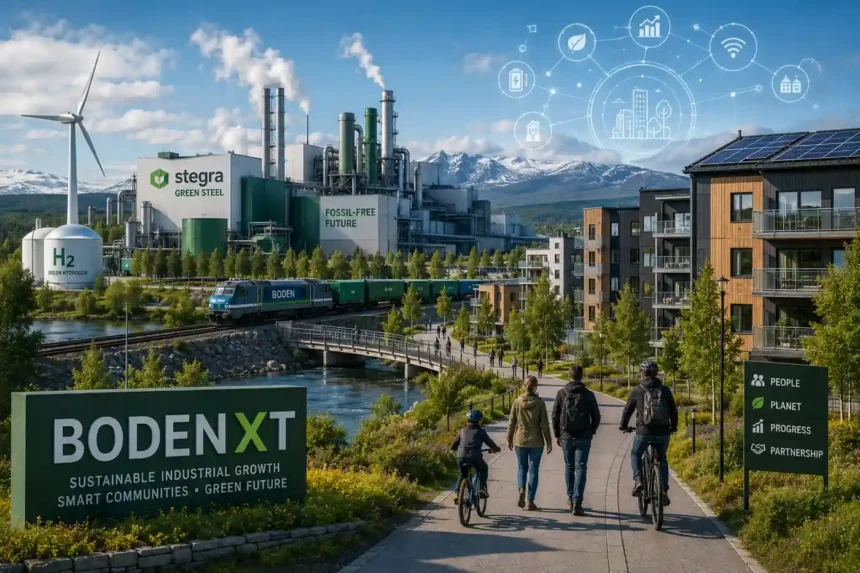
Bodenxt is a coordinated development initiative based in Boden, northern Sweden, designed to manage rapid industrial expansion while building sustainable, future-ready communities. It operates as a structured platform that connects green industrial investment with housing growth, workforce development, digital infrastructure, and climate responsibility. The initiative has drawn global attention because it demonstrates how industrial transformation and environmental sustainability can work together rather than compete.
What Is Bodenxt?
At its core, Bodenxt functions as a strategic development model — not just a policy framework or a branding exercise. It brings together municipal authorities, private industries, educational institutions, and residents under one coordinated approach to manage growth responsibly.
The model emerged from a pressing reality: the Boden region was experiencing industrial investment at a pace far beyond what traditional urban planning could handle. Rather than letting growth happen reactively, the municipality structured it into five interconnected sub-projects covering skills supply, living and housing, business development, infrastructure, and sustainability.
What sets Bodenxt apart from conventional development programs is its integration. Housing policy connects to workforce planning. Digital infrastructure connects to industrial capacity. Climate strategy connects to economic development. Every system reinforces the others.
The Origin and Vision Behind Bodenxt
Northern Sweden holds strategic advantages that have made it a target for large-scale green investment — abundant renewable electricity, strong industrial potential, and access to key European supply chains. Global climate policies have simultaneously increased pressure on traditional industries to reduce carbon emissions and shift toward fossil-free production systems.

Bodenxt developed as Boden’s structured response to these converging forces. With approximately 1,400 billion SEK being invested in green reindustrialisation across northern Sweden, the municipality recognized that absorbing 20 years of development within just a few years required a different kind of planning. The vision is straightforward: ensure industrial investment improves long-term quality of life for current and future generations, not just short-term economic output.
The Industrial Catalyst Behind Bodenxt
Stegra and Green Steel Production
The single most significant driver behind Bodenxt’s rapid acceleration is Stegra, formerly known as H2 Green Steel. Stegra is constructing what is expected to be the world’s first large-scale green steel plant in Boden. The plant uses renewable electricity and hydrogen technology instead of coal-based manufacturing, dramatically reducing carbon emissions across the entire production process.
A new round of financing worth approximately SEK 16 billion confirmed that construction would continue, signaling strong investor confidence in fossil-free steel as a viable global industry.
Europe’s Largest Hydrogen Plant
Alongside the steel facility, Boden Industrial Park is home to Europe’s largest hydrogen plant, currently under construction. The project, which involves electrolysis technology powered by renewable electricity, represents a major step in moving green technology from laboratory research into full-scale industrial application.
Railway and Logistics Infrastructure
Supporting all of this industrial activity required major transport investment. A new six-kilometre railway with ten bridges was completed at Boden Industrial Park — one month ahead of schedule and under budget. The PPP procurement model used for the project, managed by procurement officer Inger Lundberg, was nominated for a national award. The railway strengthens supply chains, improves logistics efficiency, and connects the industrial park to broader regional transport networks.
Bodenxt and Compressed Urban Development
Traditional cities grow over decades. Bodenxt operates under a compressed timeline where housing, transportation networks, healthcare facilities, schools, and digital infrastructure must all expand simultaneously — not sequentially.
The population in Boden reached 28,260 residents in 2025, surpassing year-end forecasts before July. In-migration from outside the county increased by 42 percent, with Stegra alone attracting over 600 new residents to the municipality.
This pace creates pressure. Housing shortages have emerged as one of the most urgent challenges, with an acute deficit threatening to slow Boden’s development momentum. The municipality is actively planning new residential areas, including temporary contractor housing with 712 beds in the Moråsen area, while Bodenbo has completed 50 new apartments on Brogatan for permanent residents.
The key principle of Bodenxt’s approach is synchronization — expanding neighborhoods, public institutions, and services at the same time as industrial capacity, not after.
Core Pillars That Define Bodenxt
Skills Supply and Workforce Development
Bodenxt places workforce readiness at the center of its planning. Partnerships with technical schools and universities support retraining and upskilling programs. The municipality launched a new engineering programme to prepare local residents for jobs in industry and defence. A job matching service — supported by robot Charlie, an AI-powered HR tool — connects employers with qualified local candidates quickly and efficiently. Every week, new employee groups complete introduction sessions at Stegra, arriving from countries across the world.
Living, Housing, and Community Growth
Housing growth is tracked as carefully as industrial output under Bodenxt. In addition to new apartment buildings, the initiative supports temporary housing for contractor workers, digital and personalized move-in models for relocating employees, and dedicated programs for accompanying partners — the families and spouses who move alongside new hires. Building Södra Svartbyn has also received infrastructure improvements, including a new pedestrian and cycling bridge connecting residential areas to recreational grounds at Gruvberget.
Business and Economic Development
Local businesses aren’t passive observers — they’re active participants. Around half of the surveyed companies in Boden already report tangible new business opportunities connected to the green transition. A new municipal growth programme is under review to adapt to the current phase of industrial transformation. Companies like Atacama from Germany are exploring how waste heat and residual materials from industrial processes can generate entirely new business streams. According to a Sweco report, Stegra’s contribution to GDP is projected at SEK 43 billion by 2035.
Infrastructure Innovation
Physical and digital infrastructure investment runs parallel to industrial growth. The Svedjan wastewater treatment plant is undergoing expansion to handle increased population and stricter treatment standards. Smart city technologies support energy management, traffic coordination, and public utility monitoring. New digital public services reduce administrative delays for residents managing housing, permits, or employment queries.
Sustainability and Climate Resilience
Boden was selected for the Viable Cities programme and the Climate Neutral Cities 2030 initiative — a national effort focused on achieving climate neutrality across Swedish municipalities. The Boden Sustainability Center (BSC), led by Christine Musembi, is progressing through a three-stage development plan designed to embed social sustainability into the green transition. Insect-based aquaculture feed trials at Vattenfall’s Heden facility and regenerative agriculture experiments at Strömnäsgården reflect the initiative’s breadth beyond heavy industry.
Digitalization and Smart Infrastructure
Digital infrastructure plays an enabling role across every Bodenxt pillar. Smart city technologies allow the municipality to manage energy systems, public utilities, and transportation through real-time monitoring rather than reactive maintenance. AI-assisted planning tools improve long-term forecasting accuracy.
Hive Digital Technologies invested $66 million (approximately 660 million SEK) in Boden in 2021 for high-performance computing equipment. That investment now positions Boden as a potential hub for AI development — adding a technology dimension to what began as a green industrial initiative.
Social Transformation and Community Development
Industrial growth reshapes communities in ways that go beyond economics. Bodenxt recognizes that rapid population change can weaken local identity and social bonds if not actively managed. Integration programs help international newcomers connect with local labor markets. Public spaces are designed to support cultural exchange and community participation, not just utility. Crime levels in Boden have remained low despite rapid growth, supported by close cooperation between municipal services and law enforcement.
Research by Viktor Salenius from Oxford University’s Saïd Business School confirmed that Stegra’s decision to locate in Boden was not accidental — it reflected the municipality’s track record for coordinated, trust-based development.
Bodenxt in the Global Green Economy
Bodenxt sits inside a much larger global shift. Europe’s green transformation is accelerating demand for renewable energy, low-carbon supply chains, and climate-neutral manufacturing. Regions that can provide renewable electricity, skilled labor, and coordinated governance are gaining strategic importance in international markets.
Boden now serves as a case study for how municipalities can participate actively in this global transition. The Boden model has been recognized as a benchmark in green transition research, offering lessons for other regions managing similar industrial investment pressures.
Challenges Facing Bodenxt
| Challenge | Description |
| Housing shortage | Acute deficit threatening to limit workforce attraction |
| Infrastructure pace | Systems must expand faster than traditional timelines allow |
| Governance complexity | Coordinating multiple large-scale projects simultaneously |
| Economic uncertainty | Dependence on industrial investment creates vulnerability to market shifts |
| Social cohesion | Rapid population change can strain local identity and community ties |
| Environmental risk | Industrial expansion requires continuous sustainability monitoring |
Benefits of Bodenxt
- Job creation in renewable energy, steel, logistics, digital, and public services
- Climate leadership is improving Sweden’s and Europe’s green manufacturing credentials
- Infrastructure investment raises the quality of life for all residents
- Innovation ecosystems connecting industries, researchers, and entrepreneurs
- Global competitiveness as demand grows for low-emission industrial production
- Community resilience through inclusive planning and social investment
Why Bodenxt Matters in 2026 and Beyond
Climate urgency, energy transition, and industrial modernization are reshaping economic systems globally. Cities and regions that develop coordinated frameworks now will adapt faster to future disruption. Bodenxt demonstrates that human-centered planning and industrial competitiveness are not in conflict — they reinforce each other when managed strategically. As renewable energy economies expand internationally, integrated models like this one will increasingly influence how governments, investors, and communities plan for growth.
Future Outlook of Bodenxt
The trajectory points toward continued expansion. Research collaboration with international universities, educational partnerships, and participation in European sustainability initiatives position Boden for long-term relevance. Smart city strategies and climate adaptation systems developed here may serve as templates for municipalities globally. The initiative’s greatest long-term advantage is resilience — communities that balance growth with sustainability adapt better to environmental and economic uncertainty than those that pursue growth alone.
Conclusion
Bodenxt combines green industrial innovation, smart infrastructure, workforce development, and community-focused planning into one integrated model. The initiative shows that economic growth and environmental responsibility can operate together when coordination replaces fragmentation. Affordable housing, digital connectivity, renewable energy, climate-neutral industry, and social inclusion are not competing priorities here — they are managed as a single system. For municipalities and regions facing similar pressures, the Boden approach offers a practical and well-documented framework worth examining closely.
FAQs
What does Bodenxt stand for?
Bodenxt is a long-term development initiative based in Boden, Sweden. It focuses on sustainable growth, green industrial innovation, and community empowerment. While rooted in the Boden region, its principles can apply globally.
Where is Bodenxt located?
Bodenxt is centered in the municipality of Boden in northern Sweden. The region’s access to renewable electricity and its strategic position within European supply chains make it a natural hub for green industrial investment.
How is Bodenxt connected to green steel production?
Stegra’s green steel plant in Boden is one of the initiative’s primary industrial catalysts. The plant uses renewable electricity and hydrogen technology to produce fossil-free steel, significantly reducing carbon emissions compared to traditional coal-based methods.
What makes Bodenxt different from traditional urban development?
Traditional urban growth typically happens gradually over decades. Bodenxt operates under compressed timelines where housing, transportation, healthcare, education, and infrastructure must expand simultaneously to keep pace with rapid industrial investment and population growth.
Who benefits from Bodenxt?
Residents, businesses, entrepreneurs, investors, students, and policymakers all benefit. The initiative creates employment, improves infrastructure, supports affordable housing, and strengthens community services across the entire municipality.
How does Bodenxt support sustainability?
Through renewable energy integration, climate-neutral industrial strategies, green housing development, eco-smart logistics, and participation in programs like Viable Cities and Climate Neutral Cities 2030, the initiative keeps environmental responsibility central to every decision.
Can other cities follow the Bodenxt model?
Yes. The framework’s core principles — coordinated planning, public-private cooperation, renewable energy integration, digital infrastructure, and community inclusion — are transferable. Researchers at Oxford University have already identified the Boden model as a global benchmark for green transition management.
Is Bodenxt only about industrial development?
No. While industrial investment is the primary driver, the initiative covers housing, education, community development, social sustainability, and digitalization. It treats all of these as interconnected systems rather than separate policy areas.