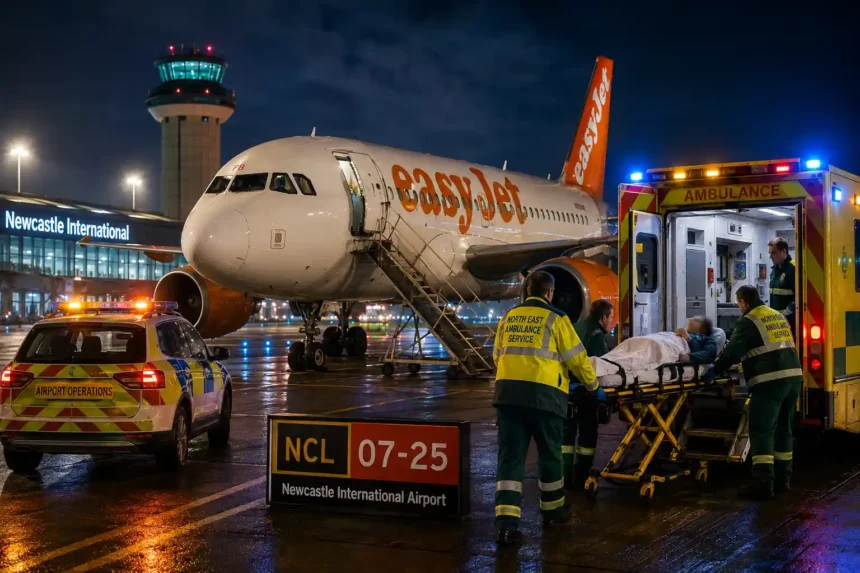
On 27 October 2025, easyJet flight U2238 made an emergency landing at Newcastle International Airport after a passenger fell critically ill mid-flight. The aircraft, operating from Copenhagen Airport (CPH) to Manchester Airport (MAN), diverted over the North Sea and touched down safely before 11 PM GMT. Every system involved — crew, air traffic control, and ground emergency services — responded exactly as trained.
This article covers what happened, why Newcastle was chosen, how the crew handled it, and what passengers need to know about their rights.
What Happened on EasyJet Flight U2238
Flight Details and Timeline
Flight EZY2238 pushed back from Copenhagen at 22:13 CET on Monday, 27 October 2025 — already 28 minutes behind its scheduled 21:45 departure. The aircraft was an Airbus A320-214, registration G-EZPB, carrying 178 passengers across 180 available seats, with six crew members on board.
The route was routine. Copenhagen to Manchester typically takes just over two hours, and nothing unusual was reported during boarding or initial climb.
| Detail | Information |
| Flight Number | U2238 / EZY2238 |
| Route | Copenhagen (CPH) → Manchester (MAN) |
| Aircraft | Airbus A320-214 (G-EZPB) |
| Passengers | 178 |
| Crew | 6 |
| Departure | 22:13 CET (28 mins late) |
| Diversion Airport | Newcastle (NCL) |
| Newcastle Landing | ~22:52 GMT |
| Manchester Arrival | ~00:28 GMT (28 Oct) |
The Onboard Medical Emergency
Less than 15 minutes after takeoff, a passenger began showing signs of serious illness. Breathing difficulties and physical weakness became apparent quickly. Cabin crew assessed the situation and escalated immediately to the flight deck — exactly as aviation regulations require.
The crew administered first aid using the onboard medical kit, provided oxygen support, and checked whether any medically trained passengers on board could assist. Within minutes, it was clear the passenger’s condition required urgent hospital care, not just in-flight management.
Emergency Declaration and Squawk 7700
Once the flight deck received the cabin crew’s report, the pilots activated squawk 7700 — the international transponder code for a general aviation emergency. This signal broadcasts the aircraft’s distress situation to all air traffic control facilities within range, triggering immediate priority handling.
UK air traffic control responded at once. The flight was cleared through the surrounding airspace, and coordination with Newcastle International Airport began immediately. From declaration to landing, the entire sequence was controlled and structured.
The same code was activated during the United Airlines flight UA770 emergency diversion, where a pressurisation fault triggered an identical ATC priority response over the English Channel
Why Newcastle Airport Was Chosen for the Diversion
Newcastle was not a random choice. Several specific factors made it the right diversion point at that moment:
- Proximity — Newcastle International Airport (ICAO: EGNT, IATA: NCL) sat closest to the aircraft’s position over the North Sea, reducing time to emergency care
- Runway capability — Runway 07/25 measures 2,330 metres, fully sufficient for A320 operations
- Emergency certification — The airport holds CAA Public Use Aerodrome Licence P725, requiring Rescue and Firefighting Services to reach any runway point within three minutes
- easyJet focus city — Type-familiar ground crew and established procedures were already in place
- Hospital access — Newcastle’s road links to major medical facilities allowed rapid patient transfer after landing
Manchester was still approximately 30 minutes away when the emergency was declared. Those 30 minutes matter when a passenger needs a Level 1 trauma centre.
Emergency Response and Medical Handling at Newcastle
North East Ambulance Service paramedics were positioned at the runway before the aircraft even landed. The moment G-EZPB stopped, medical teams boarded immediately.
The passenger was assessed on board, then transferred directly to the Royal Victoria Infirmary in Newcastle — a Level 1 trauma centre. The entire process, from emergency declaration to hospital arrival, took roughly one hour.
No other passengers or crew members required medical attention during or after the incident.
Aircraft and Crew Preparedness
Pilot Decision-Making Process
Pilots don’t divert based on instinct alone. They follow a structured framework called Aeronautical Decision-Making (ADM) — a formal process that evaluates risk, available options, and the safest course of action under pressure.
For the U2238 diversion, the ADM process weighed:
- Severity of the passenger’s condition
- Distance to nearest suitable airports
- Runway length and aircraft compatibility
- ATC coverage and certified rescue firefighting availability
- Medical infrastructure within reach on the ground
Newcastle met every requirement. The decision was made quickly, but it was not rushed — it followed a defined structure that commercial aviation has refined over decades.
Cabin Crew Response and Passenger Communication
While the pilots coordinated with ATC, the cabin crew managed the passengers and kept the rest of the aircraft calm. Clear, honest communication prevented panic. EasyJet’s announcement to passengers was direct: “We’re very sorry that your flight has now been diverted. This is due to a passenger welfare issue.”
That kind of transparency matters. Passengers who understand what is happening are significantly easier to manage than those left in silence. The crew’s professionalism throughout kept the flight orderly from declaration to landing.
Flight Resumption and Passenger Impact
After the sick passenger was transferred to medical care, G-EZPB was cleared and resumed its journey to Manchester. The aircraft arrived at approximately 00:28 GMT on 28 October, 1 hour and 43 minutes behind schedule. The remaining 177 passengers reached Manchester before 1 AM.
Post-incident checks on G-EZPB confirmed no technical faults. The diversion was caused entirely by the onboard medical emergency. The aircraft returned to service the same night.
EasyJet’s Official Statement and Passenger Rights
EasyJet issued a clear statement following the incident:
“Flight EZY2238 from Copenhagen to Manchester on 27 October diverted to Newcastle, due to a customer on board requiring urgent medical attention. The customer was met by medical services on arrival, and the flight continued to Manchester. The safety and well-being of our customers and crew is always easyJet’s highest priority.”
On the question of compensation, easyJet formally classified the disruption as an extraordinary circumstance under UK261 (the UK’s air passenger rights regulation, aligned with EU Regulation 261/2004). Under this classification, airlines are not required to pay financial compensation when a delay results from circumstances outside their control.
The delay to Manchester was 1 hour and 43 minutes — also below the three-hour threshold that would independently trigger compensation rights. Neither condition for a compensation claim was met. Passengers had no legal entitlement to a payout, though they were entitled to care and assistance during the delay.
U2238 Flight Code Confusion Explained
Several early news reports mixed up the flight codes, so this is worth clarifying directly.
EasyJet uses U2 as its IATA airline code on tickets and schedules. Radar tracking systems display the designator EZY. The result is that the same physical flight appears under different identifiers depending on where you look:
- U2238 — appears on easyJet’s own ticketing and schedule systems
- EZY2238 — displayed on radar trackers like Flightradar24
- U22238 — a variant seen on some tracking apps and early social media reports
All three refer to the same Copenhagen-to-Manchester flight that diverted to Newcastle on 27 October 2025.
The confusion was amplified because easyJet also operates a separate Newcastle to Bristol route under a similar code. That service had nothing to do with the October 2025 incident. Several published accounts incorrectly merged the two, producing factual errors that spread across aviation forums and news aggregators.
U2238 Flight Performance and Aircraft Data
Aircraft Specifications
| Specification | Detail |
| Aircraft Type | Airbus A320 / A320-214 / A320-251N |
| Total Seats | Up to 186 |
| Seat Layout | 3-3 |
| Legroom | 74 cm |
| Seat Width | 44 cm |
| Reclining Angle | 100° |
| Wi-Fi | Unavailable |
| In-Flight Entertainment | Unavailable |
On-Time Performance Statistics
Based on the last 30 recorded trips for the U2238 Newcastle–Bristol service:
| Metric | Figure |
| On-Time Departure Rate | 90% |
| On-Time Arrival Rate | 97% |
| Average Early Arrival | 9 minutes |
| Flights Cancelled | 0% |
| 30+ Mins Late (Departure) | 10% |
Data sourced from VariFlight via Trip.com and cross-referenced with Flightradar24 historical records.
Flight History Records
Flightradar24 and Trip.com both log individual legs under tail numbers including G-EZTJ, G-EZPD, G-EZUZ, G-UJEA, and G-EZTH. Each entry records STD (scheduled time of departure), ATD (actual time of departure), and STA (scheduled time of arrival), with KML and CSV export options available for Silver, Gold, and Business subscribers.
How Common Are Medical Diversions in Aviation
More common than most passengers realise. Aviation experts consistently note that medical emergencies rank among the most frequent causes of unscheduled landings — often surpassing mechanical issues in total frequency.
A comparable example is the Delta Flight DL275 diversion, where a Rolls-Royce engine fault over the Bering Sea forced the crew to reverse course mid-flight — same protocol, different cause — human life takes priority over schedule.
Airlines train for these situations extensively because the decision to divert is never risk-free. It costs money, disrupts schedules, and stresses passengers. But the alternative — continuing to a scheduled destination when a passenger’s condition is deteriorating — is not an option that modern aviation accepts.
Conclusion
The easyJet flight U2238 emergency landing at Newcastle on 27 October 2025 demonstrated how well aviation safety systems function under real pressure. From the squawk 7700 declaration over the North Sea, to North East Ambulance Service paramedics waiting at the runway, to the patient reaching the Royal Victoria Infirmary within an hour — every step worked.
G-EZPB resumed service the same night. The 177 remaining passengers reached Manchester. EasyJet’s classification under UK261 meant no compensation was owed, but the handling of the incident itself reflected the safety-first culture the airline maintains.
For anyone affected by a similar diversion, the key takeaway is straightforward: crew decisions in these situations follow strict, tested protocols. The inconvenience is real, but so is the reasoning behind every call made that night.
FAQs
What caused the EasyJet flight U2238 emergency landing at Newcastle?
A passenger fell critically ill less than 15 minutes after the flight departed Copenhagen. The cabin crew assessed the situation and escalated to the flight deck. The pilots declared a general aviation emergency and diverted to Newcastle, the nearest suitable airport, on 27 October 2025.
What is squawk 7700 and why was it used on U2238?
Squawk 7700 is the international transponder code for a general aviation emergency. Activating it broadcasts the aircraft’s distress situation to all nearby air traffic control facilities, triggering immediate priority clearance and ground coordination. The U2238 crew activated it over the North Sea once the medical situation was confirmed serious.
Why was Newcastle Airport chosen instead of Manchester?
Newcastle was significantly closer to the aircraft’s position over the North Sea at the time of the emergency. It also held the necessary certifications — CAA Licence P725, a 2,330-metre runway compatible with A320 operations, and rapid access to the Royal Victoria Infirmary. Manchester was still roughly 30 minutes away.
Were passengers on U2238 entitled to compensation?
No. EasyJet classified the disruption as an extraordinary circumstance under UK261, aligned with EU Regulation 261/2004. A medical emergency meets that definition. The delay was also 1 hour and 43 minutes — below the three-hour threshold that triggers independent compensation rights.
What aircraft operated EasyJet flight U2238?
The aircraft was an Airbus A320-214, registered as G-EZPB. It carried 178 passengers across 180 available seats. Post-incident checks confirmed no technical faults. The diversion was caused by the onboard medical emergency, not any mechanical issue.
What is the difference between U2238, U22238, and EZY2238?
All three refer to the same Copenhagen-to-Manchester flight that diverted to Newcastle. U2238 appears on easyJet’s ticketing systems, EZY2238 on radar platforms like Flightradar24, and U22238 on various tracking apps. A separate easyJet Newcastle–Bristol service shares a similar code, which caused confusion in early reports.
What happened to the sick passenger after landing at Newcastle?
North East Ambulance Service paramedics were already positioned at the runway on arrival. The passenger was assessed on board and transferred directly to the Royal Victoria Infirmary — a Level 1 trauma centre in Newcastle. Neither easyJet nor NHS trusts disclosed the patient’s identity or diagnosis under standard medical confidentiality rules.
Did the flight continue to Manchester after the emergency landing?
Yes. Once the passenger was transferred to medical care and G-EZPB was cleared, the flight resumed. It arrived at Manchester at approximately 00:28 GMT on 28 October 2025 — 1 hour and 43 minutes late. The remaining 177 passengers reached their destination safely, and the aircraft returned to service the same night.