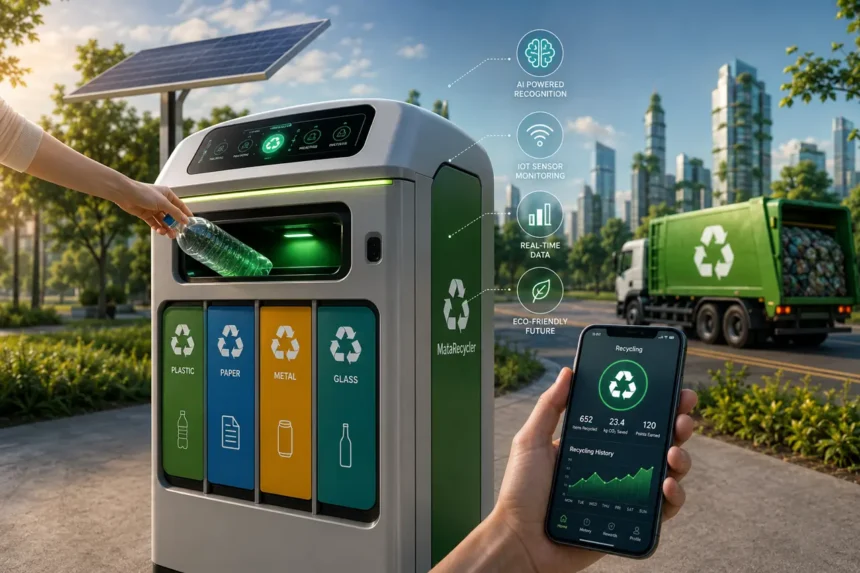
MataRecycler is an AI-powered waste management platform that uses computer vision, IoT sensors, and machine learning to sort, track, and manage recyclable materials with up to 98% accuracy. It is built for households, businesses, and cities that need a faster, cleaner alternative to manual recycling. Unlike traditional bins that rely on human sorting, MataRecycler automates the entire process — from material identification to collection routing — through a connected digital ecosystem.
Recycling rates worldwide remain dangerously low. The World Bank estimates that only 13.5% of global waste is recycled. The gap between what should be recycled and what actually gets processed keeps growing. MataRecycler was designed specifically to close that gap.
What Is MataRecycler?
MataRecycler is a digital platform built to stop useful materials from ending up in landfills. It identifies waste automatically, sorts it correctly, and sends real-time data to a central management system. The platform operates across residential buildings, commercial facilities, and municipal waste networks.
Its core mission is straightforward: ensure that nothing recyclable gets discarded by mistake. Every plastic bottle, aluminum can, or paper sheet that enters the system gets classified and directed to the right recycling stream automatically.
Core Technologies Behind MataRecycler
Three foundational technologies power the platform:

- Artificial Intelligence — reads material type using camera-based recognition and trained models
- IoT sensors — monitor bin fill levels, detect waste patterns, and send live updates to the cloud
- Machine Learning — continuously refines sorting decisions based on new data inputs
Beyond these three, MataRecycler also incorporates blockchain technology for end-to-end material tracking — from the moment waste enters a bin to when it reaches a recycling facility. Cloud-based analytics then convert that raw data into sustainability dashboards that managers and city officials can access remotely.
How MataRecycler Works
When a user places waste into a smart bin, built-in sensors scan the item immediately. The AI analyzes its shape, density, and chemical composition to determine whether it belongs with paper, plastic, metal, or glass. High-speed sorting arms then move the item into the correct compartment.
The entire process runs at 80 to 120 picks per minute — two to four times faster than a human sorter working on a busy shift. Once sorted, users receive a notification through the MataRecycler app confirming the action. The system logs every item, feeding the central platform with data used for collection planning and user feedback.

The Global Waste Crisis MataRecycler Aims to Solve
The numbers are staggering. The world generates over 2 billion tonnes of solid waste every year. The World Bank projects that figure could reach 3.4 to 3.86 billion tonnes by 2050 if no serious action is taken. UNEP places municipal solid waste alone at 2.1 billion tonnes in 2023, with costs rising sharply alongside volume.
In the United States, the EPA reports that Americans produce roughly 292 million tons of solid waste annually — about 4.9 pounds per person per day. Only 32% of that waste is recycled or composted. In lower-income countries, the recycling rate is near zero in many regions, with millions lacking basic waste collection services entirely.
The climate impact compounds the problem. Landfills rank as the third largest source of methane emissions in the U.S., contributing approximately 14.3% of domestic methane output. Methane is more than 80 times more potent than CO₂ over a 20-year window. Meanwhile, roughly 8 million metric tons of plastic flow into the world’s oceans each year.
Why Traditional Recycling Systems Are Broken
Sorting recyclables by hand was never a scalable solution. Workers at most recycling centers stand beside fast-moving conveyor belts and must classify 30 to 40 items per minute. Fatigue leads to errors, and errors lead to contamination.
The Recycling Partnership found contamination rates in U.S. curbside programs running between 17% and 25%. When contamination is too high — greasy food containers, plastic bags, Styrofoam mixed into clean loads — entire batches get rejected and sent to the landfill. All the sorting effort is wasted.
China’s National Sword policy in 2018 made the problem impossible to ignore. When China stopped accepting recyclable imports from the U.S. and Europe, many cities quietly reduced or eliminated their recycling programs. The system did not need minor repairs. It needed a complete rebuild.
Key Features of MataRecycler Platform
The platform combines hardware, software, and user-facing tools into one integrated system:
- Automated waste recognition — classifies materials without human input
- Fill-level monitoring — bins report capacity in real time, so trucks only travel when needed
- Predictive maintenance — alerts maintenance teams before equipment fails
- Cloud dashboards — give managers live visibility into waste volumes, recycling rates, and system health
- App gamification — users earn points and rewards for recycling correctly, increasing participation
Smart Collection and Route Optimization
One of the most practical features is predictive waste collection routing. Rather than running collection trucks on fixed schedules, MataRecycler routes vehicles based on actual bin fill levels. This eliminates unnecessary trips, cuts fuel use, and reduces labor costs.
Fewer collection trips also translate directly into lower carbon emissions — a measurable contribution to carbon footprint reduction goals for cities and businesses operating under environmental targets.
Mobile App and User Dashboard
The MataRecycler app serves as the user-facing layer of the entire platform. It guides people on correct disposal choices, tracks recycling habits over time, and supports reward programs that keep engagement high.
For businesses, the dashboard generates automated CSR reports and supports ESG reporting requirements. For municipalities, it provides measurable recycling performance data across districts. Transparency at every level is built into the design.
Core Technology: AI, IoT, and Machine Learning in MataRecycler
Artificial Intelligence in Waste Sorting
The AI component handles material classification at scale. Using computer vision, it identifies items based on visual shape, surface texture, and known material profiles. Accuracy sits between 95% and 98% — significantly above the 85% to 90% achievable by human sorters on a standard shift.
Consistency is the real advantage. Unlike human workers, the AI does not slow down, does not get confused by similar-looking materials, and does not make errors due to fatigue.
IoT Integration and Real-Time Tracking
IoT bins connect every physical unit in the network to the central platform. They report fill levels, flag unusual waste patterns, and feed environmental monitoring systems with live data. This real-time visibility allows collection teams to react immediately rather than discovering problems after the fact.
Machine Learning for Continuous Improvement
The platform improves as it processes more waste. Machine learning models update continuously, refining classification decisions based on new material types, packaging changes, and regional recycling rule variations. A bin in one city learns from data collected across the entire network.
Cloud Analytics and Data Flow
Once data leaves the bins, it moves into a cloud-based analytics infrastructure. There, raw inputs become structured insights: usage patterns, contamination rates, material volumes, and collection efficiency metrics. Businesses and municipalities use these reports to adjust strategy, document progress, and plan future investments — all without waiting for slow manual reporting cycles.
Environmental Impact of MataRecycler
Better sorting produces measurable environmental results:
| Material | Environmental Saving |
| Aluminum | 95% less energy vs. new production from bauxite ore |
| Paper (1 tonne) | Saves 17 trees and 7,000 gallons of water |
| Plastic (1 tonne) | Saves energy equal to 1,000–2,000 gallons of gasoline |
The EPA estimates that recycling and composting in the U.S. prevented approximately 186 million metric tons of CO₂-equivalent emissions in 2018 alone — equal to removing 39 million cars from the road for a full year. Scaling that impact globally through smarter systems like MataRecycler makes it one of the most practical emissions-reduction tools available.
In developing nations, improving recycling infrastructure could prevent billions of tonnes of waste from contaminating rivers, groundwater, and drinking water sources currently serving hundreds of millions of people.
Benefits of MataRecycler for Households, Businesses, and Cities
Benefits for Households
For households and apartment buildings, MataRecycler removes the main barrier to recycling: confusion. The app explains exactly what goes where, tracks recycling activity, and provides feedback that builds habits over time. Smaller system versions are available for residential neighborhoods that connect directly to the mobile app.
Benefits for Businesses and Industries
Companies using the platform typically see a 40% to 60% reduction in landfill fees. Offices, factories, campuses, and retail spaces can track recyclable output, reduce contamination in their waste streams, and meet environmental regulations with documented proof. Automated CSR reporting simplifies compliance with ESG requirements that many investors and regulatory bodies now require.
Benefits for Smart Cities and Municipalities
Cities gain real-time control over recycling infrastructure. Smart city integration allows municipalities to monitor collection schedules, identify low-performance zones, and optimize routes without manual intervention. The result is lower operational costs, less overflow, and measurable progress toward circular economy targets.
MataRecycler vs Traditional Recycling Systems
| Metric | MataRecycler | Traditional System |
| Sorting Accuracy | 95–98% | 85–90% |
| Speed | 80–120 picks/min | 30–40 picks/min |
| Contamination Rate | Under 5% | 17–25% |
| Cost Savings | 30–50% | None |
| Real-Time Data | Yes | No |
| Route Optimization | Yes | No |
The gap is not marginal. At high waste volumes, the difference between 95% and 85% accuracy means thousands of tonnes of material either recovered or lost to landfill every month.
Real-World Results and Case Studies
On the Greek island of Kefalonia, an EU-funded project called RECLAIM deployed a portable AI recycling facility small enough to fit inside a shipping container. During tourist season — when monthly waste volumes increase by at least 60% — the system maintained 98% classification accuracy across seven material types at 120 picks per minute.
In San Jose, California, technology-assisted contamination detection helped the city reach a waste diversion rate above 80% — one of the highest for any major U.S. city. AMP Robotics, based in Colorado, operates AI sorting systems across facilities in North America and Europe, handling up to 80 picks per minute per robotic arm continuously.
In a separate neighborhood pilot, waste collection rates rose 40% within six months after residents began using the app to track progress and receive feedback. Most municipal deployments recover their infrastructure investment within two years through saved labor and disposal fees.
Economic Benefits and Cost Efficiency
The financial case is strong. U.S. landfill tipping fees have increased 3% to 4% annually over the past decade, and that trend continues upward. Businesses using smart recycling programs report cutting those costs by 40% to 60% by diverting more material back into supply chains as sellable recovered material.
At the national level, the EPA reports that the U.S. recycling and reuse industry already supports 681,000 jobs and pays $37.8 billion in wages annually. The World Economic Forum estimates the circular economy could generate $4.5 trillion in economic value globally by 2030. Smart recycling infrastructure is what makes the circular economy physically possible.
Community Awareness and Engagement
A 2023 Recycling Partnership survey found that 94% of Americans consider recycling important. Similar attitudes appear across Europe, Asia, and Latin America. The barrier is not motivation — it is confusion and distrust about whether recycling actually works.
MataRecycler addresses this through educational programs in schools and workplaces, digital tools that explain local recycling rules clearly, and incentive programs that reward consistent participation. When users see their materials tracked from bin to end product, the feedback loop closes and participation stays high. Community engagement is not optional — it determines whether the technology delivers results at scale.
Challenges and Limitations of MataRecycler
No platform is without friction. The main challenges include:
- Upfront cost — smart bins, AI software, and installation require significant investment, which can be a barrier for small towns or low-budget municipalities
- Internet dependency — the system requires a stable connection to send data to the cloud; areas with poor connectivity face operational gaps
- Job transition — automation reduces demand for manual sorting roles, though most deployments transition those workers into tech maintenance positions
- Behavior change — technology alone does not guarantee results; clear communication, good design, and sustained user support are all required for long-term adoption
Pilot programs in smaller areas before full deployment help reduce both cost risk and adoption friction.
Future of MataRecycler Technology
The next technical frontier involves materials that current systems struggle with — composite plastics, multilayer packaging, and electronic waste. Americans alone generate roughly 6.9 million tons of e-waste per year, according to the Consumer Technology Association, yet only 15% is properly recycled. Vast quantities of gold, silver, copper, and rare earth elements are currently buried or incinerated instead of recovered.
Engineers are testing solar panel integration directly into bin units so facilities can operate without grid dependency. Smart city systems are also expanding — bins that signal fill levels in real time, collection routes that update automatically, and processing data shared live with city managers. These models are already being piloted across cities in Europe and Asia, and they represent the direction MataRecycler is actively building toward.
Global expansion into Southeast Asia, Sub-Saharan Africa, and Latin America — regions where the gap between waste generated and waste properly managed is widest — remains a primary growth objective.
Conclusion
MataRecycler delivers a measurable, practical improvement over every traditional recycling system it replaces. By combining AI-powered sorting, IoT infrastructure, machine learning, and real-time cloud analytics, it achieves accuracy rates that manual systems cannot match and contamination levels that manual systems cannot prevent.
For households, it removes confusion. For businesses, it cuts costs and simplifies ESG compliance. For cities, it provides the infrastructure needed to pursue genuine circular economy goals. The technology is not theoretical — real-world case studies across Europe, the U.S., and beyond confirm that smarter recycling infrastructure delivers results within months of deployment.
The waste problem will not shrink on its own. What changes is whether the systems handling it are built for the scale and complexity the problem actually demands. MataRecycler is one of the clearest answers available today.
FAQs
What is MataRecycler and how does it work?
MataRecycler is an AI-powered waste management platform that uses IoT sensors, computer vision, and machine learning to automatically identify and sort recyclables. Waste placed in a smart bin is scanned, classified by material type, and directed to the correct collection stream — all without manual input.
How accurate is MataRecycler’s waste sorting?
The system reaches 95% to 98% sorting accuracy, compared to 85% to 90% for manual human sorters. The AI does not slow down or make fatigue-related errors, which makes its accuracy consistent across high-volume operations.
What makes MataRecycler different from traditional recycling bins?
Traditional bins rely on users sorting waste correctly and staff manually processing it at facilities. MataRecycler automates material detection, tracks every item via app, optimizes collection routes in real time, and generates data reports — none of which traditional systems can do.
Can MataRecycler be used for homes and apartments?
Yes. Smaller versions of the system are available for apartment buildings and residential neighborhoods. These connect to the mobile app, which guides users on correct disposal and tracks recycling activity over time.
How does MataRecycler reduce landfill waste and contamination?
By classifying materials at 95–98% accuracy, the system keeps contamination below 5% — far below the 17–25% seen in standard curbside programs. Clean, correctly sorted material is accepted by recycling facilities rather than rejected and sent to landfill.
What are the cost benefits of MataRecycler for businesses and cities?
Businesses typically reduce landfill disposal fees by 40% to 60%. Cities save on labor and unnecessary collection trips through optimized routing. Most deployments recover their initial investment within two years through operational savings.
Does MataRecycler support circular economy and ESG goals?
Yes. The platform tracks material flows from bin to recycling facility, generates automated CSR and ESG reports, and supports compliance with environmental regulations. It directly enables circular economy practices by recovering materials that would otherwise be lost to landfill.
What is the future roadmap for MataRecycler?
Upcoming developments include recognition systems for composite plastics and multilayer packaging, integration of solar panels into bin units, expanded e-waste processing, and broader deployment in Southeast Asia, Sub-Saharan Africa, and Latin America. Smart city integration — with live data shared directly with municipal management systems — is also in active development.