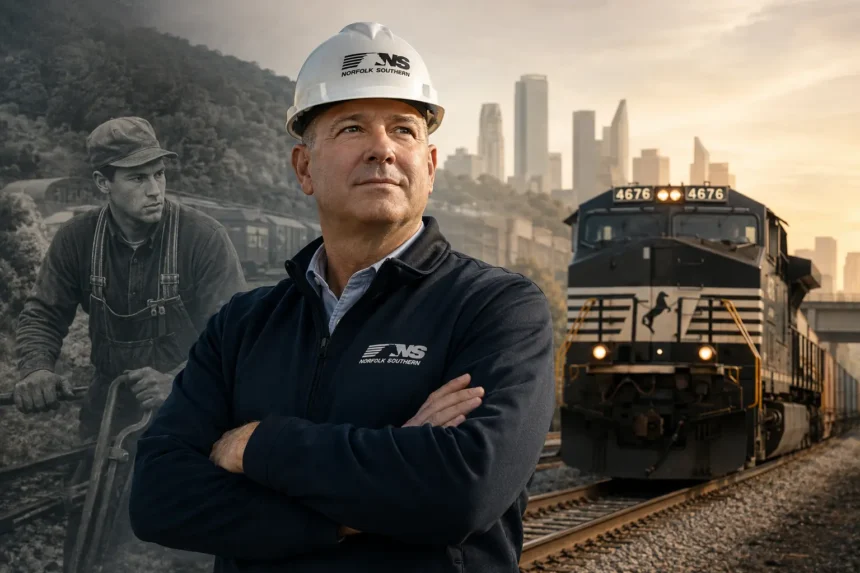
Claude Edward Elkins Jr. is an American railroad executive best known as the Executive Vice President and Chief Commercial Officer at Norfolk Southern Corporation. He built his entire career within one company — starting as a road brakeman in 1988 and rising to one of the highest commercial leadership roles in the U.S. freight railroad industry. His story is not about overnight success. It is about decades of field experience, continued education, and consistent performance.
Who Is Claude Edward Elkins Jr.?
Ed Elkins, as he is professionally known, is a transportation executive at Norfolk Southern — one of the largest freight railroad companies in the United States. His career spans operations, marketing, intermodal business, and corporate strategy, all within the same organization.
What sets him apart from many C-suite executives is that he did not enter the industry through a corporate or consulting route. He started at the track level, doing the physical, demanding work of railroad operations. That foundation shaped how he leads, how he understands the business, and how he connects with employees across every level of the company.
Quick Bio
| Field | Details |
| Full Name | Claude Edward “Ed” Elkins Jr. |
| Birthplace | Southwest Virginia |
| Military Background | United States Marine Corps veteran |
| Career Start | Norfolk Southern, 1988 (Road Brakeman) |
| Education | BA in English, University of Virginia’s College at Wise; MBA in Port & Maritime Economics, Old Dominion University; Certificates from Harvard Business School, UVA Darden, University of Tennessee Supply Chain Institute |
| Current Role | Executive Vice President & Chief Commercial Officer, Norfolk Southern |
| Board Memberships | Georgia Chamber of Commerce (Vice Chair), National Association of Manufacturers, East Lake Foundation, TTX Company |
Early Life and Upbringing
Claude Edward Elkins Jr. grew up in Southwest Virginia, a region where railroad work was a real part of daily life and the local economy. The Appalachian community he grew up in was tight-knit and practical. People were valued for their reliability, honesty, and work ethic — not their credentials.
That environment built a foundation of discipline and perseverance in him early. Hard work was expected. Character mattered more than status. These values stayed consistent throughout his professional life.
Family and Community Influence
His family reinforced the community’s values of integrity and commitment. Growing up with strong moral grounding shaped how he would later approach leadership — with honesty and a genuine respect for the people doing the real work. The community didn’t produce executives who managed from a distance. It produced people who understood labor, responsibility, and trust.
Military Service and Discipline
Before joining Norfolk Southern, Elkins served in the United States Marine Corps. Military training sharpens specific skills: discipline under pressure, structured decision-making, physical and mental toughness, and the ability to lead without clarity. These are not abstract traits. They are practical tools that translate directly into managing complex operations and making high-stakes commercial decisions.

His Marine Corps background gave him an edge that formal business education alone cannot replicate.
Education and Academic Foundation
Elkins pursued education at each stage of his career — not just at the beginning. He earned a Bachelor of Arts in English from the University of Virginia’s College at Wise. That degree built communication and critical thinking skills, both of which are essential in marketing, negotiations, and executive leadership.
Later, he completed an MBA in Port and Maritime Economics from Old Dominion University. This aligned his academic knowledge directly with the logistics and transportation realities of the railroad industry. He also completed advanced programs at Harvard Business School, UVA Darden School, and the University of Tennessee Supply Chain Institute.
The pattern here matters: he did not stop learning after reaching a senior role. Each program added a specific layer — strategy, supply chain management, transportation economics — that made him more effective at each stage of his career.
Career Journey at Norfolk Southern
Starting as a Road Brakeman (1988)
In 1988, Elkins joined Norfolk Southern as a road brakeman. The role demands physical endurance, safety awareness, and close coordination with rail crews. There is no shortcut through it. He worked at the track level, experienced the operational demands firsthand, and built a detailed understanding of how freight railroads actually function.
This was not a symbolic starting point. It was the real thing.
Rise Through Operational Roles
From brakeman, he advanced through a series of frontline roles:
- Conductor — managing train movements and crew operations
- Locomotive Engineer — operating trains directly
- Relief Yardmaster — overseeing yard activity and train positioning
Each role added depth. By the time he transitioned out of operations, he understood rail operations, crew responsibilities, and transportation service in a way that most marketing or strategy professionals never do.
Transition into Marketing and Commercial Leadership
In the mid-2000s, Elkins moved into Intermodal Marketing at Norfolk Southern. This shift required him to apply operational knowledge to customer-facing business problems — understanding freight dynamics, pricing, logistics, service expectations, and long-term business relationships.
It was a significant pivot. Moving from physical operations to commercial strategy required new skills, but his field background became an asset. He could speak credibly to customers about what the railroad could and could not do — a credibility that purely academic or financial executives often lack.
Executive Promotions and Appointments
His commercial performance drove steady advancement:
| Year | Role |
| 2016 | Group Vice President, Chemicals Marketing |
| 2018 | Vice President, Industrial Products |
| December 2021 | Executive Vice President & Chief Commercial Officer |
Each promotion expanded both his business scope and his responsibility for revenue growth and market development across Norfolk Southern’s core freight segments.
Role as Executive Vice President and Chief Commercial Officer
As EVP and Chief Commercial Officer at Norfolk Southern, Elkins oversees multiple business units that drive the company’s commercial performance. These include:
- Intermodal
- Automotive
- Industrial Products
- Real Estate
- Industrial Development
- Short Line Marketing
- Field Sales
- Customer Logistics
Norfolk Southern is a Fortune 500 company. The commercial strategy Elkins manages directly affects how rail capacity is sold, how customer contracts are structured, and how the railroad positions itself against competing freight modes. The role demands both long-term strategic vision and the ability to respond to short-term market shifts.
Leadership Style and Philosophy
Ground-Level Operational Understanding
One of the clearest advantages Elkins brings to executive leadership is that he has worked alongside frontline employees. He understands the challenges railroad workers face in keeping freight moving. That understanding shapes how he makes decisions — not just from a financial or strategic lens, but from an operational reality check.
Executives who have never done the work often make decisions that look good on paper but fail in execution. His background reduces that gap.
Customer-Centric Approach
Elkins built his commercial career around customer satisfaction and service reliability. In the transportation market, reliability is the product. Customers choose freight carriers based on whether shipments arrive on time and whether problems get resolved quickly. His focus on customer trust and long-term business relationships reflects a practical understanding of what drives freight revenue.
Adaptability and Versatility
His career required continuous adaptation — from brakeman to conductor, engineer to yardmaster, then into marketing, sales, and finally the C-suite. Each transition demanded learning new skills and abandoning comfortable ones. That level of sustained adaptability across decades is rare, and it is a defining feature of his professional identity.
Impact on the Railroad Industry
Under his commercial leadership, Norfolk Southern has worked to improve operational efficiency, strengthen safety culture, and advance sustainability practices. He has supported the adoption of better logistics planning tools and smarter use of rail assets across the freight network.
Safety standards and environmental responsibility have been consistent priorities. In an industry that operates under significant regulatory and public scrutiny, maintaining safety culture at scale requires both policy and cultural commitment — not just compliance checkboxes.
His influence extends across the supply chain. Industries that depend on freight transportation — automotive, chemicals, agriculture, and manufacturing — are directly affected by the commercial decisions his team makes.
Community and Industry Contributions
Elkins has served on boards and committees that extend his influence beyond Norfolk Southern’s commercial operations:
- Georgia Chamber of Commerce — Vice Chair
- National Association of Manufacturers — Board Member
- East Lake Foundation — Board Member
- TTX Company — Board Member
These roles connect him to economic development, manufacturing policy, and community welfare at a regional and national level. His involvement demonstrates that his leadership approach includes civic engagement alongside corporate responsibility.
Beyond board service, he has supported mentorship programs, education and outreach initiatives, youth empowerment, and community health awareness campaigns — reflecting a consistent pattern of contributing to the communities connected to Norfolk Southern’s network.
Legacy and Recognition
The legacy Claude Edward Elkins Jr. is building rests on a rare combination: real operational credibility, sustained commercial performance, and a leadership style grounded in integrity and perseverance.
He has received awards and professional recognition throughout his career, but the more durable form of recognition comes from the trust he has built — with employees, customers, and industry peers. Future generations of railroad professionals and business leaders can draw practical lessons from his path: that starting at the bottom is not a disadvantage, that education compounds over time, and that adaptability is more valuable than any single credential.
Conclusion
Claude Edward Elkins Jr. started as a road brakeman at Norfolk Southern in 1988 and built his way to Executive Vice President and Chief Commercial Officer through field experience, continuous education, and consistent performance. His career in the railroad industry demonstrates that professional excellence comes from understanding the work at every level — not just managing it from above.
His story offers a practical model for career development: combine military discipline with academic growth, build operational credibility before moving into strategy, and stay adaptable across decades of change. For anyone studying American railroad leadership, business success, or long-term career development, Ed Elkins represents one of the clearest examples available.
FAQs
Who is Claude Edward Elkins Jr.?
Claude Edward “Ed” Elkins Jr. is an American railroad executive serving as Executive Vice President and Chief Commercial Officer at Norfolk Southern Corporation.
When did Claude Edward Elkins Jr. start his career at Norfolk Southern?
He joined Norfolk Southern in 1988 as a road brakeman, following his service in the United States Marine Corps.
What is Claude Edward Elkins Jr.’s educational background?
He holds a BA in English from the University of Virginia’s College at Wise and an MBA in Port and Maritime Economics from Old Dominion University. He also completed executive programs at Harvard Business School, UVA Darden, and the University of Tennessee Supply Chain Institute.
What are his responsibilities as Chief Commercial Officer?
He oversees Intermodal, Automotive, Industrial Products, Real Estate, Industrial Development, Short Line Marketing, Field Sales, and Customer Logistics — driving commercial strategy and revenue growth across Norfolk Southern.
What leadership roles did he hold before becoming EVP?
He served as Group Vice President of Chemicals Marketing (2016) and Vice President of Industrial Products (2018) before his appointment as EVP and Chief Commercial Officer in December 2021.
What community boards is Claude Edward Elkins Jr. involved in?
He serves on the Georgia Chamber of Commerce (Vice Chair), National Association of Manufacturers, East Lake Foundation, and TTX Company.
What makes his career path unusual for a railroad executive?
Most senior executives enter through corporate or financial routes. Elkins started as a frontline road brakeman and advanced through every operational level before moving into commercial leadership — giving him direct industry experience that is rare at the C-suite level.
What is the legacy of Claude Edward Elkins Jr.?
His legacy centers on integrity, perseverance, and the practical proof that deep operational experience combined with continuous education can lead to the highest levels of corporate leadership in the railroad industry.