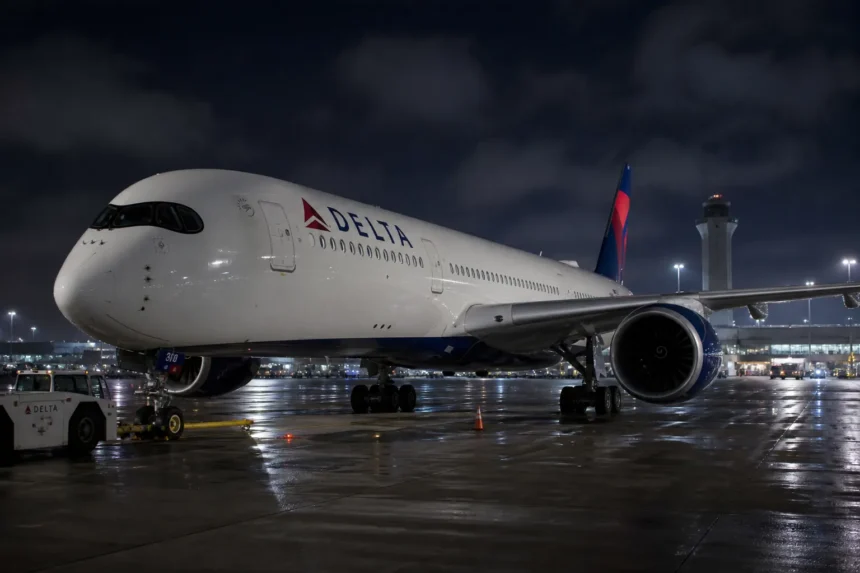
Delta Flight DL275 diverted to LAX on May 27, 2025, after a critical engine system failure forced the crew to abandon its scheduled route from Detroit to Tokyo. The Airbus A350-900, registration N508DN, turned around over the Bering Sea and landed safely at Los Angeles International Airport at 01:08 AM on May 28. No passengers were injured.
Here is the full breakdown — the cause, the timeline, the cost, and what this incident reveals about modern aviation safety.
What Happened — Delta Flight DL275 Diverted to LAX
DL275 departed Detroit Metropolitan Wayne County Airport (DTW) at 15:53 local time, already running late due to a delayed inbound flight — DL133 from Amsterdam Schiphol Airport, which landed over an hour behind schedule.
The aircraft climbed to cruise altitude and followed its standard transpacific route. Approximately five hours into the flight, while flying over the Bering Sea — roughly 620 nautical miles southwest of Anchorage, Alaska — the crew identified a serious technical malfunction. Rather than continuing toward Tokyo Haneda Airport (HND), the pilots reversed course and headed southeast toward LAX.
The aircraft landed on Runway 06R at 01:08 AM on May 28, 2025. Total time in the air from DTW: 12 hours and 15 minutes — nearly as long as the full scheduled flight to Tokyo.

Flight Details and Route Summary
Flight Route and Aircraft Specifications
| Detail | Data |
| Flight Number | DL275 |
| Origin | Detroit Metro (DTW) |
| Destination | Tokyo Haneda (HND) |
| Diversion Airport | Los Angeles International (LAX) |
| Aircraft | Airbus A350-900 |
| Registration | N508DN |
| Aircraft Age | 7.31 years |
| Scheduled Duration | ~13 hours |
| Actual Air Time | 12 hours 15 minutes |
Delta operates DL275 as a daily transpacific service. The Airbus A350-900 is the airline’s preferred aircraft for these long-haul routes, and Delta currently operates 37 examples of the type. The airline has also announced plans to transition to an all-A350 fleet across its continental transpacific network by 2026.
Timeline of Events
- ~13:19 local — Inbound aircraft (DL133 from Amsterdam) lands late at DTW
- 15:53 local — DL275 departs DTW from gate A46, delayed by nearly two hours
- ~5 hours into flight — Crew detects engine system fault over the Bering Sea
- Course reversal — Aircraft turns southeast toward Los Angeles
- 01:08 AM, May 28 — DL275 lands on Runway 06R at LAX
- Total flight time — 12 hours 15 minutes
Cause of Diversion — Engine Anti-Ice System Failure
What Is an Anti-Ice System and How It Failed
The Rolls-Royce Trent XWB engines powering the A350-900 include an anti-ice system designed to prevent ice buildup on engine components during high-altitude flight. The system works by routing heated air — typically reaching 400 to 600 degrees Fahrenheit — across critical engine parts.
At cruise altitude in icy upper-atmosphere conditions, a failure in this system is not a minor inconvenience. If ice forms on engine components, it can cause compressor stalls, damage fan blades, or trigger a full engine shutdown.

Sensor data aboard N508DN began showing abnormal readings, indicating the anti-ice system was degrading rapidly. The crew had no reliable path to Tokyo with a compromised system operating over open ocean in freezing conditions.
How the Crew Responded
The flight crew followed standard emergency procedures. No mayday was declared, but the diversion was treated as a precautionary emergency given the nature of the fault.
Flight attendants made a cabin announcement explaining that a technical issue required an early landing. Passengers reported no turbulence, panic, or visible disturbance in the cabin. Multiple accounts from onboard — including posts in a widely circulated Reddit thread — described the captain as calm and communicative throughout.
The aircraft landed without incident. All passengers and crew were safe.
Why LAX Was Chosen as the Emergency Diversion Airport
Technical and Maintenance Capabilities
LAX is one of Delta’s largest hubs on the West Coast and holds certified maintenance facilities for wide-body aircraft, including the Airbus A350. Rolls-Royce engine support is available 24/7 at the airport, with Trent XWB parts and technical inventory on-site.
For a fault involving a Rolls-Royce engine system, LAX offered faster diagnosis and repair than almost any other diversion option along the Pacific route. A commercial pilot with over 15 years of experience noted that for transpacific flights, returning to a major maintenance hub is standard protocol the moment an engine system shows faults.

Passenger and Operational Factors
With multiple daily flights operating between LAX and Tokyo, rebooking over 300 passengers became significantly more manageable. The airport also offered:
- Long runways capable of handling a heavy wide-body with a large remaining fuel load
- Favorable weather conditions for the arrival
- Full on-site emergency services
- Hotel accommodation options for displaced passengers
Passenger Experience and Airline Response
Inside the cabin, the diversion was handled with minimal disruption. Flight attendants followed protocol throughout, keeping communication clear and the atmosphere controlled.
Delta provided meal vouchers, hotel accommodations, and rebooking options to affected passengers. Those with connecting flights received additional support depending on their situation and the airline’s standard compensation policy.
Passenger reactions on social media — particularly on the Reddit thread that emerged quickly after landing — were largely positive toward the crew. Business class passengers noted the tension was palpable, but the professionalism of the captain kept the mood stable.
Delta did not issue a detailed public statement immediately, but confirmed the diversion and stated the decision was made out of an abundance of caution. Rolls-Royce engineers were brought in to determine the root cause and prevent recurrence.
Financial and Operational Impact of the Diversion
The unplanned diversion carried a high cost. Estimates place the total financial impact on Delta at approximately $2.3 million, broken down across:
| Cost Category | Estimated Impact |
| Fuel (extra flight time) | High |
| Aircraft inspection and repairs | High |
| Passenger rebooking and care | Moderate |
| Revenue loss (missed route) | Moderate |
Aircraft N508DN was grounded at LAX for inspection following the landing. No fleet-wide action was taken, confirming the issue was isolated to this aircraft. The FAA requested cockpit voice recorder data and system logs as part of the standard post-diversion review. The NTSB did not step in, indicating the incident — while serious — was not catastrophic.
How Technology Could Prevent Future Diversions
Aviation experts believe this specific failure could have been detected before departure. AI-driven predictive maintenance systems, if integrated into Delta’s pre-flight protocols, may have identified early warning signs in the Trent XWB’s anti-ice system as many as 3 to 6 hours before the aircraft left the gate.
The Airbus A350 already includes redundant systems and real-time onboard diagnostics. Third-party monitoring tools like FlightAware Premium can provide additional data layers for ground teams. The gap is not in available technology — it is in how proactively data gets acted on.
Key capabilities that could reduce future incidents:
- Real-time engine health monitoring that flags anomalies during pre-flight checks
- AI-driven diagnostic tools that cross-reference sensor data across fleet history
- Predictive alerts are pushed to maintenance crews before boarding is complete
For Delta and the broader aviation industry, this diversion reinforces one clear message: reactive maintenance on long-haul transpacific routes carries enormous financial and safety risk. Proactive systems are no longer optional.
What Travelers Should Know and Do Next
If DL275 or a similar Delta route is in your travel plans, here is what to monitor:
- Check the Delta app for live flight status and rebooking options
- Track N508DN via FlightAware or Flightradar24 to confirm the aircraft’s return to service
- Passengers affected by the diversion can request compensation through Delta’s standard airline policy
- Those with connecting flights through LAX or DTW should build buffer time into Pacific itineraries
Delta’s LAX-to-Tokyo service continued operating on other aircraft while N508DN remained grounded for inspection. Operations normalized within days.
The Bigger Picture — Aviation Safety Lessons from DL275
This diversion was not a catastrophe — but it was a warning. A $2.3 million unplanned event on a well-maintained modern aircraft, operated by a major airline with an experienced crew, exposed a gap between what today’s technology can detect and what actually gets flagged before departure.
The aviation industry is moving toward smarter systems. AI-driven diagnostics, real-time fleet monitoring, and predictive maintenance tools are no longer experimental — they exist, and platforms like FlightAware, Flightradar24, AIRLIVE, and Simple Flying already track this data publicly. The challenge is integration and action speed.
For passengers, DL275 is a reminder that diversions happen for the right reasons. Crews are trained to prioritize safety over schedule, and LAX was the correct call. For airlines and regulators, it is a case study of where predictive technology could reduce both cost and risk on transpacific routes.
Conclusion
Delta Flight DL275’s diversion to LAX was handled correctly. The Airbus A350-900, its crew, and Delta’s ground operations all performed under pressure, and 300+ passengers landed safely. The Rolls-Royce Trent XWB fault was isolated, the aircraft was inspected, and service resumed.
What the incident leaves behind is a sharper question for the aviation industry: if the technology to catch this fault before departure already exists, why wasn’t it used? Smarter, safer flights require not just better aircraft — but faster, more proactive use of the data those aircraft already generate.
FAQs
Why did Delta Flight DL275 divert to LAX?
DL275 diverted to LAX due to a failure in the Rolls-Royce Trent XWB engine’s anti-ice system. The fault was detected over the Bering Sea, and the crew followed standard safety protocols, choosing LAX as the nearest major Delta hub with full A350 maintenance capabilities.
What aircraft was used on Delta Flight DL275?
The flight operated on an Airbus A350-900 with registration N508DN. It is a long-range wide-body aircraft that Delta uses regularly on transpacific routes between DTW and HND.
Was anyone hurt during the DL275 diversion?
No. The aircraft landed safely on Runway 06R at LAX with no injuries to passengers or crew. The landing was precautionary, not an emergency in the catastrophic sense.
How long was Delta Flight DL275 in the air before diverting?
The aircraft flew approximately five hours before the crew reversed course over the Bering Sea. By the time it landed at LAX, total airtime from DTW reached 12 hours and 15 minutes.
How much did the DL275 diversion cost Delta Air Lines?
The total estimated financial impact was approximately $2.3 million, covering fuel, aircraft repairs, passenger care, and lost route revenue.
Could AI have prevented the DL275 diversion?
Aviation experts believe predictive AI maintenance tools could have detected early warning signs in the anti-ice system 3 to 6 hours before departure. The technology exists — the gap lies in how consistently it is applied during pre-flight checks.
What compensation did passengers receive after the DL275 diversion?
Delta provided meal vouchers, hotel accommodations, and rebooking options. Passengers with missed connections received additional support based on Delta’s standard airline compensation policy. Over 300 passengers were affected.
Is it common for long-haul flights to divert mid-route?
Mid-route diversions on transpacific flights are rare. When they occur, it is almost always due to a safety concern — medical emergencies, mechanical faults, or system failures. In this case, the anti-ice system fault left the crew with no safe option other than diverting to LAX.